The Sombrero Galaxy (also known as M104 or NGC 4594) is an unbarred spiral galaxy in the constellation Virgo. It has a bright nucleus, an unusually large central bulge, and a prominent dust lane in its inclined disk. The dark dust lane and the bulge give this galaxy the appearance of a sombrero. The galaxy has an apparent magnitude of +9.0, making it easily visible with amateur telescopes. The large bulge, the central supermassive black hole, and the dust lane all attract the attention of professional astronomers.
Black Eye Galaxy
A spiral galaxy in the Coma Berenices constellation, Messier 64, the famous "Black Eye" galaxy or the "Sleeping Beauty galaxy," has a spectacular dark band of absorbing dust in front of the galaxy's bright nucleus. It is well known among amateur astronomers because of its appearance in small telescopes.
2MASX J00482185-2507365 occulting pair
The 2MASX J00482185-2507365 occulting pair is a pair of overlapping spiral galaxies found in the vicinity of NGC 253, the Sculptor Galaxy. Both galaxies are more distant than NGC 253, with the background galaxy, 2MASX J00482185-2507365, lying at redshift z=0.06, and the foreground galaxy lying between NGC 253 and the background galaxy (0.0008 < z < 0.06). This pair of galaxies illuminates the distribution of galactic dust beyond the visible arms of a spiral galaxy. The heretofore unexpected extent of dust beyond the starry limits of the arms, shows new areas for extragalactic astronomical study. The dusty arms extend 6 times the radii of the starry arms of the galaxy, and is shown silhouetted in HST images against the central and core sections of the background galaxy.
The Whirlpool Galaxy
Also known as Messier 51a, M51a, or NGC 5194, the Whirlpool Galaxy is an interacting grand-design spiral galaxy located at a distance of approximately 23 million light-years in the constellation Canes Venatici. It is one of the most famous spiral galaxies in the sky. The galaxy and its companion (NGC 5195) are easily observed by amateur astronomers, and the two galaxies may even be seen with binoculars. The Whirlpool Galaxy is also a popular target for professional astronomers, who study it to further understanding of galaxy structure (particularly structure associated with the spiral arms) and galaxy interactions.
Grand spiral galaxy
Also known as NGC 123, this fascinating galaxy is dominated by millions of bright stars and dark dust, caught up in a gravitational swirl of spiral arms rotating about the center. Open clusters containing bright blue stars can be seen sprinkled along these spiral arms, while dark lanes of dense interstellar dust can be seen sprinkled between them. Less visible, but detectable, are billions of dim normal stars and vast tracts of interstellar gas, together wielding such high mass that they dominate the dynamics of the inner galaxy. Invisible are even greater amounts of matter in a form we don't yet know - pervasive dark matter needed to explain the motions of the visible in the outer galaxy.
Supernova 1987A
Two decades ago, astronomers spotted one of the brightest exploding stars in more than 400 years: a doomed star, called Supernova 1987A. This image shows the entire region around the supernova. The most prominent feature in the image is a ring with dozens of bright spots. A shock wave of material unleashed by the stellar blast is slamming into regions along the ring's inner regions, heating them up, and causing them to glow. The ring, about a light-year across, was probably shed by the star about 20,000 years before it exploded. In the next few years, the entire ring will be ablaze as it absorbs the full force of the crash. The glowing ring is expected to become bright enough to illuminate the star's surroundings, providing astronomers with new information on how the star expelled material before the explosion. The image was taken in December 2006 with Hubble's Advanced Camera for Surveys. (Credit: NASA, ESA, and R. Kirshner; Harvard-Smithsonian Center for Astrophysics)
Galaxy NGC 1512
A barred spiral galaxy located some 30 million light years away toward the constellation Horologium, Galaxy NGC 1512 is bright enough to be seen with amateur telescopes. The galaxy is some 70,000 light years across, which is nearly as large as our own Milky Way galaxy. The core of the galaxy is remarkable for its "circumnuclear" starburst ring, which is an amazing circle of young star clusters that spans some 2400 light years across. Galaxy "starbursts" are episodes of vigorous formation of new stars and are found in various galaxy environments.
Galaxy NGC 3370
A dusty spiral galaxy located some 98 million light years away toward the constellation Leo, the center of NGC 3370 shows well delineated dust lanes and an uncommonly ill-defined nucleus. This view of NGC 3370 was obtained by the Hubble Space Telescope using the Advanced Camera for surveys and is sharp enough to identify individual Cepheid variable stars in the galaxy. Cepheid variable stars are used to establish extragalactic distances. In 1994, a Type Ia sypernova exploded in NGC 3370. (Credit: NASA, The Hubble Heritage Team and A. Riess; STScI)
M81
The big and beautiful spiral galaxy M81, in the northern constellation Ursa Major, is one of the brightest galaxies visible in the skies of planet Earth. This superbly detailed view reveals its bright nucleus, grand spiral arms and sweeping cosmic dust lanes with a scale comparable to the Milky Way. Hinting at a disorderly past, a remarkable dust lane runs straight through the disk, below and right of the galactic center, contrary to M81's other prominent spiral features. The errant dust lane may be the lingering result of a close encounter between M81 and its smaller companion galaxy, M82. Scrutiny of variable stars in M81 (aka NGC 3031) has yielded one of the best determined distances for an external galaxy -- 11.8 million light-years.
Hoag's Object
A non-typical galaxy of the type known as a ring galaxy, the appearance of Hoag's Object has interested amateur astronomers as much as its uncommon structure has fascinated professionals. Is this one galaxy or two? This question came to light in 1950 when astronomer Art Hoag chanced upon this unusual extragalactic object. On the outside is a ring dominated by bright blue stars, while near the center lies a ball of much redder stars that are likely much older. Between the two is a gap that appears almost completely dark. How Hoag's Object formed remains unknown, although similar objects have now been identified and collectively labeled as a form of ring galaxy. Genesis hypotheses include a galaxy collision billions of years ago and perturbative gravitational interactions involving an unusually shaped core. The above photo taken by the Hubble Space Telescope in July 2001 reveals unprecedented details of Hoag's Object and may yield a better understanding. Hoag's Object spans about 100,000 light years and lies about 600 million light years away toward the constellation of Serpens. Coincidentally, visible in the gap is yet another ring galaxy that likely lies far in the distance.
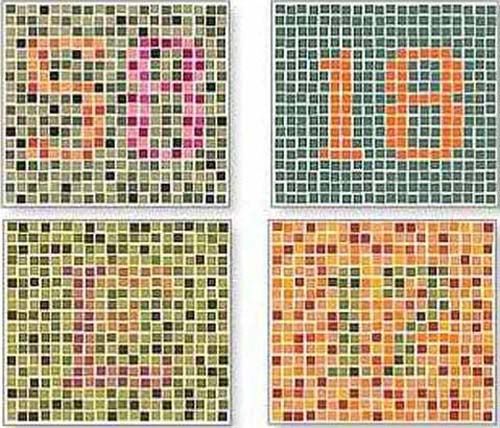
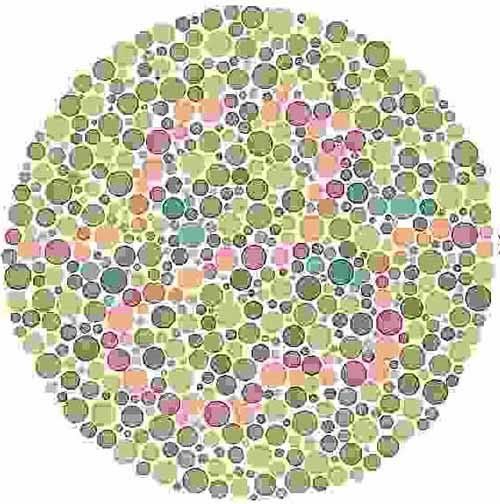
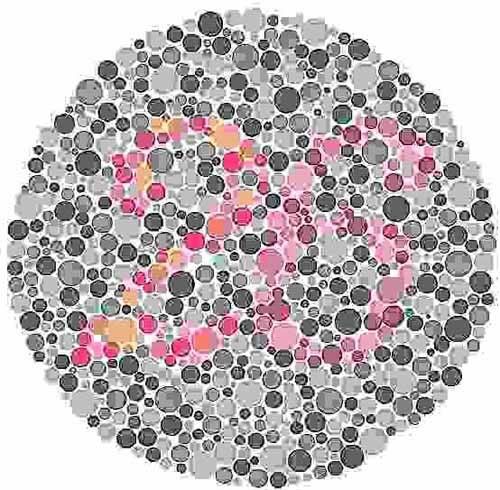
Sometimes, optical illusions can serve a purpose. These images might seem familiar to you; look closely. Do they remind you of anything? If you have a driving license, or attended a medical exam at some point in your life, there is a big chance you encountered these during the process. Attached on your left, and below you may find some examples of color blindness test used for testing if person is partially of fully color blind.
If the numbers don't jump out at you immediately, if you have hard time distinguishing the colors apart, or if you aren't able to easily distinguish at least a vague guess as to what the number is, then you my friend are unfortunately - color blind.
A version of this test can be seen used in the film Little Miss Sunshine, in which a small girl is playing with the vision test chart with her brother. He is not able to see the numbers, or tell the different colors apart well enough to distinguish the numbers. The boy's goal was to be a pilot, so when he is made aware that he's colorblind, the poor kid has a small nervous breakdown. As we already stated, color blindness, or color vision deficiency, is the inability to perceive differences between some of the colors that others can distinguish. It is most often of genetic nature, but may also occur because of the eye, nerve, or brain damage, or due to exposure to certain chemicals.
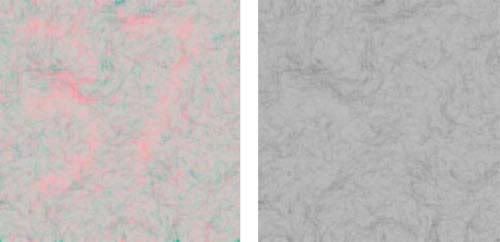
Before we proceed onto our next example, here is a little history lesson: The English chemist John Dalton published the first scientific paper on the subject in 1798, "Extraordinary facts relating to the vision of colors" after the realization of his own color blindness. Because of Dalton's work, the condition is sometimes called daltonism, although this term is now used for a specific type of color blindness, called deuteranopia. Below you may see the example how one that is colorblind can't distinguish the numbers on the card. Don't be mistaken, color blind people don't see everything in black and white, I just gave this as a guideline so you can understand their inability.
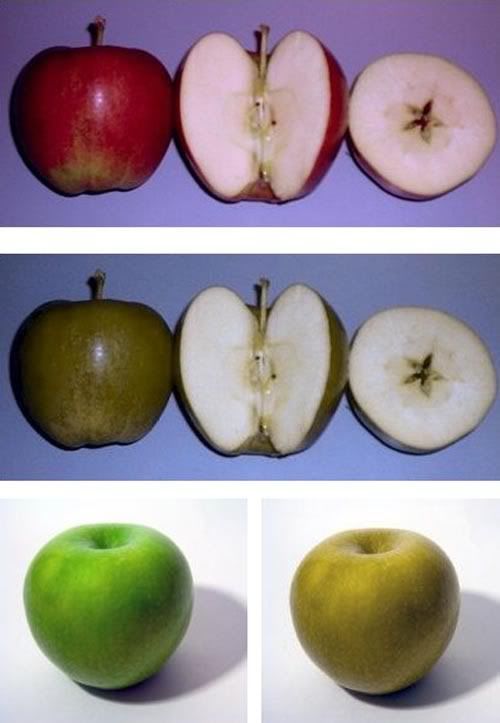
Color blindness is not the swapping of colors in the observer's eyes. Grass is never red, and stop signs are never green. The color impaired do not learn to call red "green" and vice versa. However, dichromats often confuse red and green items. For example, they may find it difficult to distinguish a Braeburn from a Granny Smith and in some cases, the red and green of a traffic light without other clues (e.g., shape or location). This is demonstrated in this simulation of the two types of apple as viewed by a trichromat or by a dichromat.
In certain situations, color blindness is classed as a disability. However, color blind people have some advantages over people with normal color vision as well! There are some studies which conclude that color blind individuals are better at penetrating certain camouflages.
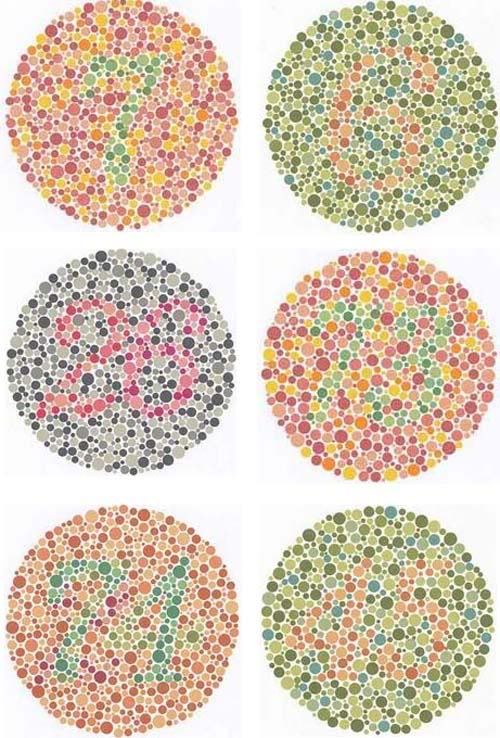
On your left, you may see another color vision test card. This one is pretty hard, as some individuals with perfect vision may have problems seeing the number inside it - it is 56 if I'm not mistaken.
Hope we learned something useful today. Before I conclude this article, there are some more vision test examples for you to enjoy:
And then some more... Examples below are much bigger in size. If you had no problem recognizing previous numbers, but have more problem distinguishing these, don't be afraid - it has nothing to do with color blindness. Probably its just that your eyes can't capture the whole image at once.
written by Vurdlak, with additional help from Vernon Southward of Macro Photography. If you would like to have your article appear on Mighty Optical Illusions as well, feel free to contact us.
Kim Ung-Yong: Attended University at age 4, Ph.D at age 15; world's highest IQ
This Korean super-genius was born in 1962 and might just be the smartest guy alive today (he's recognized by the Guinness Book of World Records as having the highest IQ of anyone on the planet). By the age of four he was already able to read in Japanese, Korean, German, and English. At his fifth birthday, he solved complicated differential and integral calculus problems. Later, on Japanese television, he demonstrated his proficiency in Chinese, Spanish, Vietnamese, Tagalog, German, English, Japanese, and Korean. Kim was listed in the Guinness Book of World Records under "Highest IQ"; the book estimated the boy's score at over 210.
Kim was a guest student of physics at Hanyang University from the age of 3 until he was 6. At the age of 7 he was invited to America by NASA. He finished his university studies, eventually getting a Ph.D. in physics at Colorado State University before he was 15. In 1974, during his university studies, he began his research work at NASA and continued this work until his return to Korea in 1978 where he decided to switch from physics to civil engineering and eventually received a doctorate in that field. Kim was offered the chance to study at the most prestigious universities in Korea, but instead chose to attend a provincial university. As of 2007 he also serves as adjunct faculty at Chungbuk National University.
Gregory Smith: Nominated for a Nobel Peace Prize at age 12
Born in 1990, Gregory Smith could read at age two and had enrolled in university at 10. But “genius” is only one half of the Greg Smith story. When not voraciously learning, this young man travels the globe as a peace and children’s rights activist.
He is the founder of International Youth Advocates, an organization that promotes principles of peace and understanding among young people throughout the world. He has met with Bill Clinton and Mikhail Gorbachev and spoke in front of the UN. For these and other humanitarian and advocacy efforts, Smith has been nominated four times for a Nobel Peace Prize. His latest achievement? He just got his driver license.
Akrit Jaswal: The Seven Year-Old Surgeon
Akrit Jaswal is a young Indian who has been called "the world's smartest boy" and it's easy to see why. His IQ is 146 and is considered the smartest person his age in India—a country of more than a billion people.
Akrit came to public attention when in 2000 he performed his first medical procedure at his family home. He was seven. His patient — a local girl who could not afford a doctor — was eight. Her hand had been burnt in a fire, causing her fingers to close into a tight fist that wouldn't open. Akrit had no formal medical training and no experience of surgery, yet he managed to free her fingers and she was able to use her hand again.
He focused his phenomenal intelligence on medicine and at the age of twelve he claimed to be on the verge of discovering a cure for cancer. He is now studying for a science degree at Chandigarh College and is the youngest student ever accepted by an Indian University.
Cleopatra Stratan: a 3 year old singer who earns 1000€ per song
Clepotra was born October 6, 2002 in Chisinau, Moldova and is the daughter of Moldovan-Romanian singer, Pavel Stratan. She is the youngest person ever to score commercial success as a singer, with her 2006 album La vârsta de trei ani ("At the age of 3"). She holds the record for being the youngest artist that performed live for two hours in front of a large audience, the highest paid young artist, the youngest artist to receive an MTV award and the youngest artist to score a #1 hit in a country ("Ghita" in Romanian Singles Chart).
Aelita Andre: The 2-year-old artist who showed her paintings in a famous Gallery
The abstract paintings of emerging artist Aelita Andre have people in Australia's art world talking. Aelita is two (the works were painted when she was even younger).
Aelita got an opportunity to show her paintings when Mark Jamieson, the director of Brunswick Street Gallery in Melbourne's Fitzroy, was asked by a photographer whose work he represented to consider the work of another artist. Jamieson liked what he saw and agreed to include it in a group show.
Jamieson then started to promote the show, printing glossy invitations and placing ads in the magazines Art Almanac and Art Collector, featuring the abstract work. Only then did he discover a crucial fact about the new artist: Aelita Andre is Kalashnikova's daughter, and was just 22 months old. Jamieson was shocked and embarrassed but decided to proceed with the exhibition anyways.
Saul Aaron Kripke: Invited to apply for a teaching post at Harvard while still in high school
A rabbi's son, Saul Aaron Kripke was born in New York and grew up in Omaha in 1940. By all accounts he was a true prodigy. In the fourth grade he discovered algebra, and by the end of grammar school he had mastered geometry and calculus and taken up philosophy. While still a teenager he wrote a series of papers that eventually transformed the study of modal logic. One of them earned a letter from the math department at Harvard, which hoped he would apply for a job until he wrote back and declined, explaining, "My mother said that I should finish high school and go to college first". After finishing high school, the college he eventually chose was Harvard.
Kripke was awarded the Schock Prize, philosophy's equivalent of the Nobel. Nowadays, he is thought to be the world's greatest living philosopher.
Michael Kevin Kearney: earned his first degree at age 10 and became a reality show Millionaire
Kearny was born in 1984 and is was known for setting several world records and teaching college at the age of 17.
He spoke his first words at four months. At the age of six months, he said to his pediatrician "I have a left ear infection" and learned to read at the age of ten months. When Michael was four, he was given diagnostic tests for the Johns Hopkins precocious math program and achieved a perfect score. He finished high school at age 6, enrolled at Santa Rosa Junior College graduating at 10 with an Associate of Science in Geology. He is listed in the Guinness Book as the world's youngest university graduate at the age of 10, receiving a bachelor's degree in anthropology. For a while, he also held the record for the world's youngest postgraduate.
But in 2006, he became worldwide famous after reaching the finals on the Mark Burnett/AOL quiz/puzzle game Gold Rush, and became the first $1 million winner in the online reality game.
Fabiano Luigi Caruana: a chess prodigy who became the youngest Grandmaster at age 14
Fabulous Fabiano is a 16-year-old chess Grandmaster and chess prodigy with dual citizenship of Italy and the United States.
On 2007 Caruana became a Grandmaster at the age of 14 years, 11 months, 20 days - the youngest Grandmaster in the history of both Italy and the United States. In the April 2009 FIDE list, he has an Elo rating of 2649, making him the world's highest ranked player under the age of 18.
Willie Mosconi: played professional Billiards at age 6
William Joseph Mosconi, nicknamed "Mr. Pocket Billiards" was a American professional pocket billiards (pool) player from Philadelphia, Pennsylvania. Willie's father owned a pool hall where he wasn’t allowed to play, but Willie improvised by practicing with small potatoes from his mother's kitchen and an old broomstick. His father soon realized that his son was a child prodigy began advertising challenge matches, and though Willie had to stand on a box in order to reach the table, he beat experienced players many years his senior.
In 1919, an exhibition match was arranged between six-year old Willie and the reigning World Champion, Ralph Greenleaf. The hall was packed, and though Greenleaf won that match, Willie played very well launching his career in professional billiards. In 1924, at the tender age of eleven, Willie was the juvenile straight pool champion and was regularly holding trick shot exhibitions.
Between the years of 1941 and 1957, he won the BCA World Championship of pool an unmatched fifteen times. Mosconi pioneered and employed numerous trick shots, set many records, and helped to popularize the game of billiards. He still holds the officially recognized straight pool high run record of 526 consecutive balls.
Elaina Smith: youngest agony aunt aged 7
Her local radio station gave her the job after she rang and offered advice to a woman caller who had been dumped. Elaina’s tip — go bowling with pals and drink a mug of milk — was so good she got a weekly slot and now advises thousands of adult listeners. The littler adviser tackles problems ranging from how to dump boyfriends and how to cope with relationship breakdown to dealing with smelly brothers.
When one listener wrote to Elaina asking how to get a man, she replied: "Shake your booty on the dance floor and listen to High School Musical". Another caller asked how to get her man back, Elaina told her: "He's not worth the heartache. Life's too short to be upset with a boy."
 The Sombrero Galaxy

 Black Eye Galaxy

 2MASX J00482185-2507365 occulting pair

 The Whirlpool Galaxy

 Grand spiral galaxy

 Supernova 1987A

 Galaxy NGC 1512

 Galaxy NGC 3370

 M81

 Hoag's Object